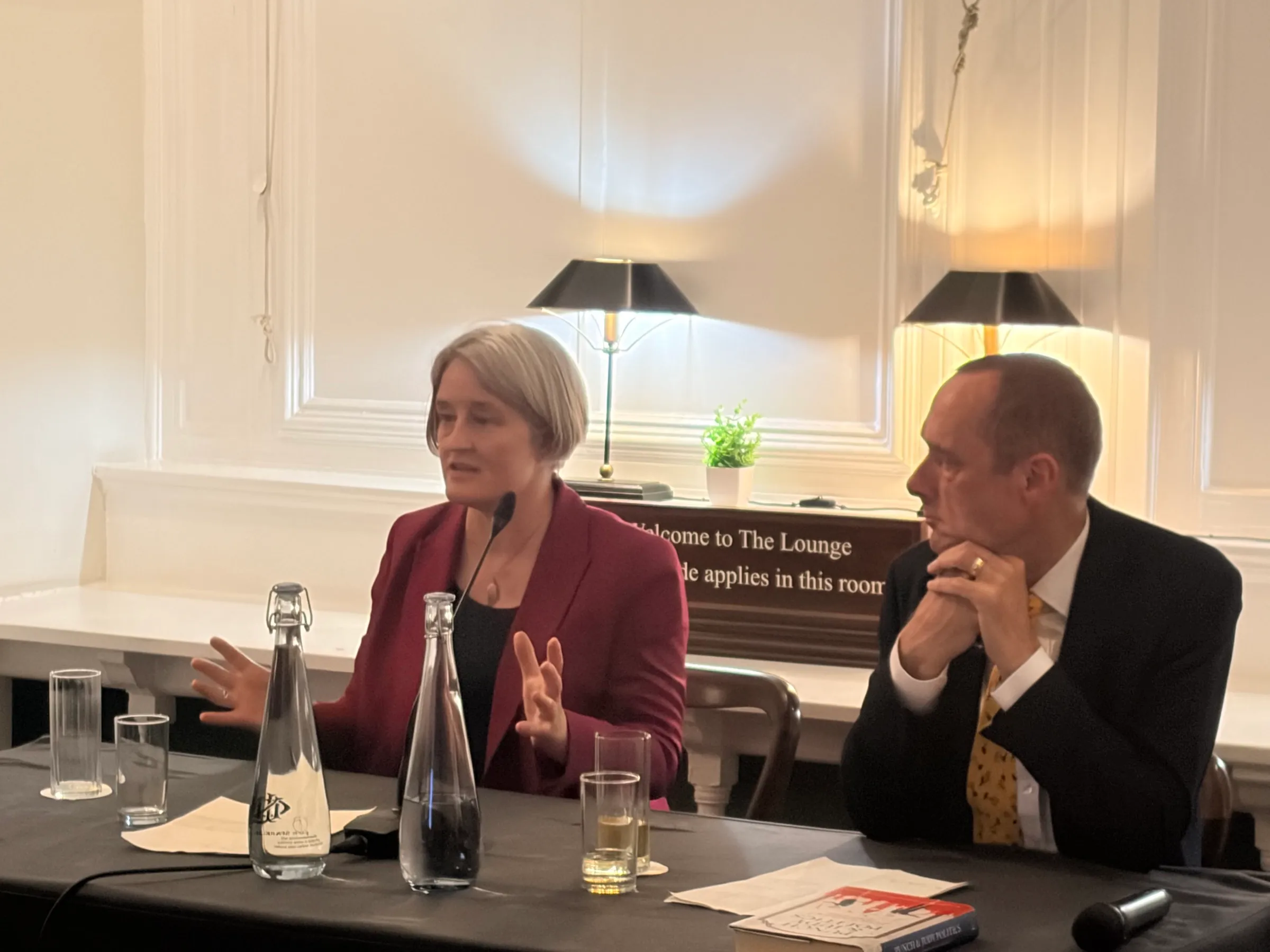
The Orpington Circle welcomed Claire Young MP, Member for Thornbury and Yate, and Earl Russell, Liberal Democrat Lords Spokesperson for Energy and Climate Change, for an evening on energy, climate and the transition to net zero.
“The biggest change in energy since the Industrial Revolution”
Earl Russell opened by describing the energy transition as the biggest change in energy since the Industrial Revolution. He said it must be both affordable and fair. With electricity demand expected to double by 2030, he argued that Britain needs to look hard at its energy mix. It is already falling behind on commitments such as the electric vehicle mandate. The UK should aim to be at the forefront of the next industrial revolution, not trailing behind it.
He described energy and climate as “two sides of the same coin”. Tackling climate change also means protecting and enhancing nature, and he criticised the Government for setting growth against nature. He also raised food security. Recent years have brought some of the worst harvests on record, Europe has had a terrible harvest, and he warned that our cold chain systems are not secure.
Taking people with you
Both speakers said the Government’s approach is too top-down. Earl Russell said Labour is “not good at taking people with them”. Citizens should be able to take part in the transition, and people need to feel they can benefit from it. “We can get there,” he said, “but we have to work together.” He noted that agreement on straightforward science can no longer be taken for granted. Misinformation and disinformation are widespread, even though people can see the effects of climate change with their own eyes.
A view from Thornbury and Yate
Claire Young brought a practical and local view. A former software engineer, she once researched the carbon cost of computing. Her constituency has wind sites and new nuclear, and the Severn offers major opportunities for tidal power. Just outside it, a science park is working on more advanced ways to power vehicles on land. She also described recently debating fracking with Richard Tice.
She said the Government’s picture on the environment is fractured. Like Earl Russell, she criticised Labour’s centralising, “we know best” instinct and argued that communities should have real local influence over the energy transition. She was concerned that the political right is trying to break the consensus on energy and net zero, even though most people support climate policies. A fair transition is key, she said. It must work for every community, especially those that rely on heavy industry or on oil and gas extraction.
Energy as security
Claire reflected on a recent trip to Europe, where energy is increasingly treated as a security issue. She asked which sovereign capabilities the UK needs and where its future security lies. Decentralised green energy, she argued, is easier to defend against aggression because it has no single point of failure. If Britain wants to lead in new industries, it will need a great deal of energy to do it.
Skills, certainty and demand
She was frank about the gaps. Britain has a major skills shortage in installing heat pumps. Older workers can be hard to retrain while demand for new technologies is still uncertain. In a rural constituency with no technical college, it is not clear where young people can get these skills. She criticised the Government’s slowness on key decisions, such as whether the gas grid can be used for hydrogen. Industry needs certainty, she said, and there is still no clear strategy on the demand side of energy use.